A different way to work on your PTSD symptoms
No medication. No retelling your trauma. Just you, learning to steady your own brain — with our team beside you.
Neuro Wellness TMS Centers of America is an authorized provider of Prism™, a prescription neurofeedback device cleared by the FDA as an adjunctive treatment for symptoms associated with PTSD.
It may not be “just how you are.” It may be PTSD.
Many people live with PTSD for years without a name for it. They just know something feels off, or that they haven’t felt like themselves in a long time. PTSD tends to show up in four patterns. You don’t need all of them, and you don’t need a single dramatic event to explain them.
When the past breaks into the present
(Intrusion)
- Memories or images that arrive uninvited
- Waves of emotion that seem to come from nowhere
- Nightmares that repeat a feeling or theme, not always the exact event
- The sense that your own mind can hijack you
When your life is built around not feeling
(Avoidance)
- Steering clear of certain places, people or conversations
- Staying so busy there's no room to think
- Going numb instead of feeling, which is protection, not personality
When you stop feeling like yourself
(Mood and thinking)
- Feeling detached from people you love
- Guilt or shame that won't let go
- Losing interest in things that used to matter
- “I'm here, but I'm not really here”
When your body won't stand down
(Hyperarousal)
- Always scanning, always on guard
- Startling easily
- Trouble falling or staying asleep
- A shorter fuse than you'd like
- Feeling unsafe even when you know you're safe
These aren’t character flaws. They’re patterns the brain learns after trauma or long-term stress, and patterns can be retrained. That’s what Prism is designed to help with.
Could this be what I’m dealing with?
A quick self-reflection
In the past month, how many of these sound like you? This isn’t a test or a diagnosis. It’s a way to notice patterns worth bringing to a clinician.
If several of these felt familiar, you’re not imagining it and you’re not alone. A consultation with our team is a low-pressure way to sort out what’s going on and what might help, whether that’s Prism or something else.
This checklist is for personal reflection only and can’t diagnose PTSD or depression. Only a qualified clinician can make a diagnosis. If you’re in crisis, call or text 988 or call 911.
Maybe you're sleeping badly, or not at all. Maybe you're on edge in ordinary places — a parking lot, a crowded room, a certain time of day. Maybe you've done the work already: therapy, medication, both, and you're still carrying more than you should have to.
You're not failing at recovery. PTSD changes how the brain handles threat, and that change doesn't respond to willpower. It responds to training.
If you're a survivor of assault, an accident, a serious illness or a natural disaster — or a Veteran carrying what you carried home — Prism may be worth discussing with our clinical team.
A prescription neurofeedback device for PTSD
Prism is a prescription medical device that uses EEG neurofeedback to help you learn to regulate brain activity associated with your PTSD symptoms.
It works alongside your existing care — it is not a replacement for therapy or medication. Prism is prescribed by a licensed healthcare professional and used together with your other treatment, which is exactly how it was studied and how it's cleared for use.
Three things make it unusual:
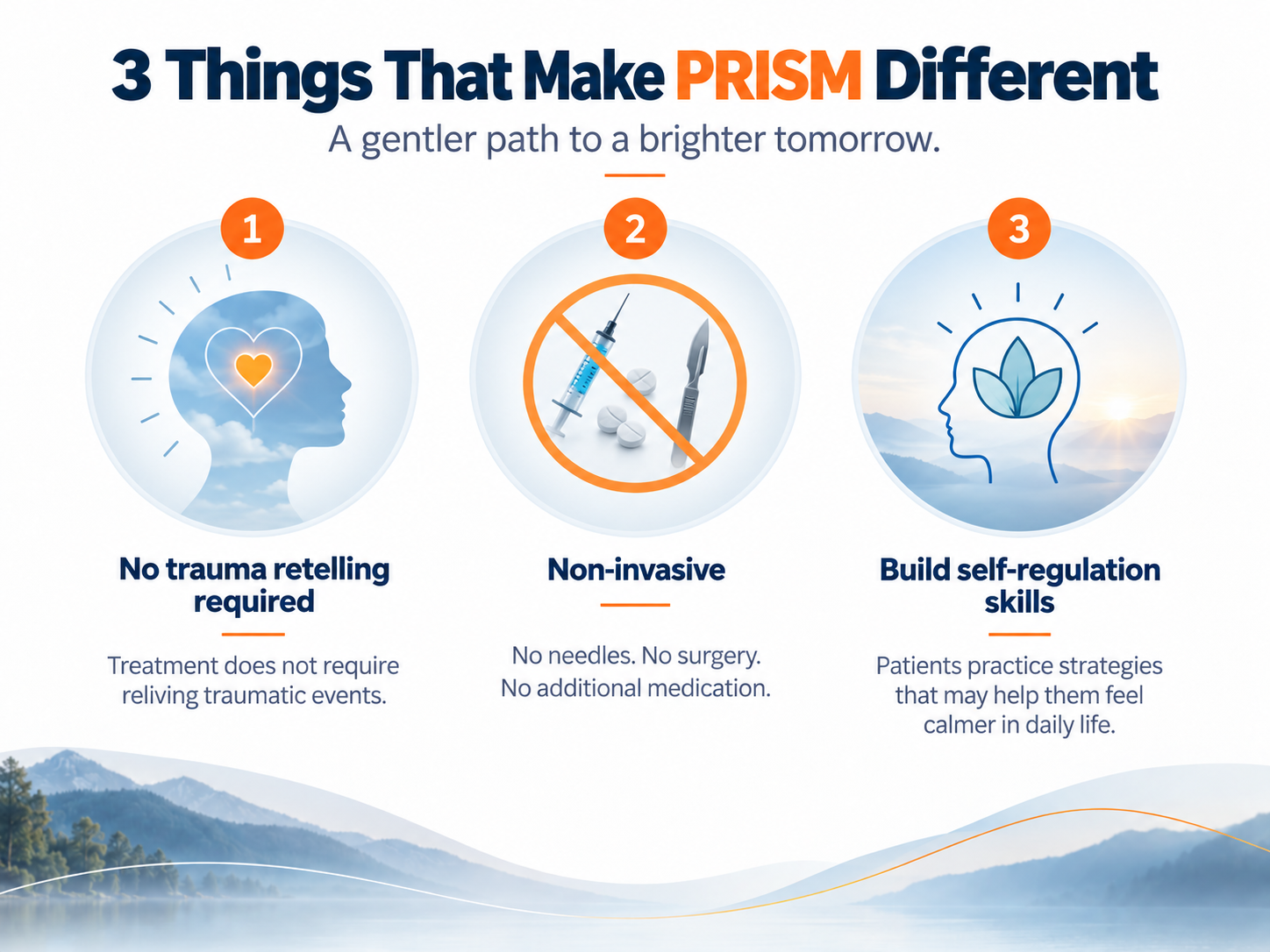
You don't talk about the trauma.
Prism doesn't ask you to describe, revisit, or re-experience what happened. Nothing about the sessions is trauma-based.
Nothing enters your body.
No injections, no radiation, no additional medication. A soft cap with sensors, resting on your scalp.
You do the work.
Prism doesn't stimulate your brain or do something to you. It shows you what your brain is doing, in real time, so you can learn to change it. The skill is yours to keep.
You can function. You just can’t feel much of anything.
A lot of people don’t recognize themselves in the word “depression” because they aren’t sad. They’re muted. Work gets done and life keeps moving, but the color has gone out of it. Clinicians call this anhedonia: a loss of the ability to feel interest, motivation or pleasure.
It can look like:
- Things you used to love feel like chores
- Getting started on anything takes enormous effort
- Being tired all the time without a clear reason
- Feeling emotionally muted, even around people you care about
- “I can function, but I'm not living”
- Life happening around you instead of with you
Where Prism fits
Alongside the FDA-cleared PTSD protocol, Prism now offers a depression protocol designed for people whose depression centers on anhedonia. Instead of targeting the brain’s alarm system, it uses a marker linked to the brain’s reward system, the circuitry behind motivation and pleasure. Sessions look much the same: an EEG cap, a screen that responds to your brain activity, and practice finding the mental strategies that move it. In a pilot study published in Brain Sciences, most participants showed a reduction in depressive symptoms.
Prism’s FDA clearance is for adjunctive treatment of symptoms associated with PTSD. The depression protocol is not FDA-cleared for the treatment of depression and is used under the direction of your clinician as part of a broader treatment plan. Research on this protocol is ongoing.
How Prism works
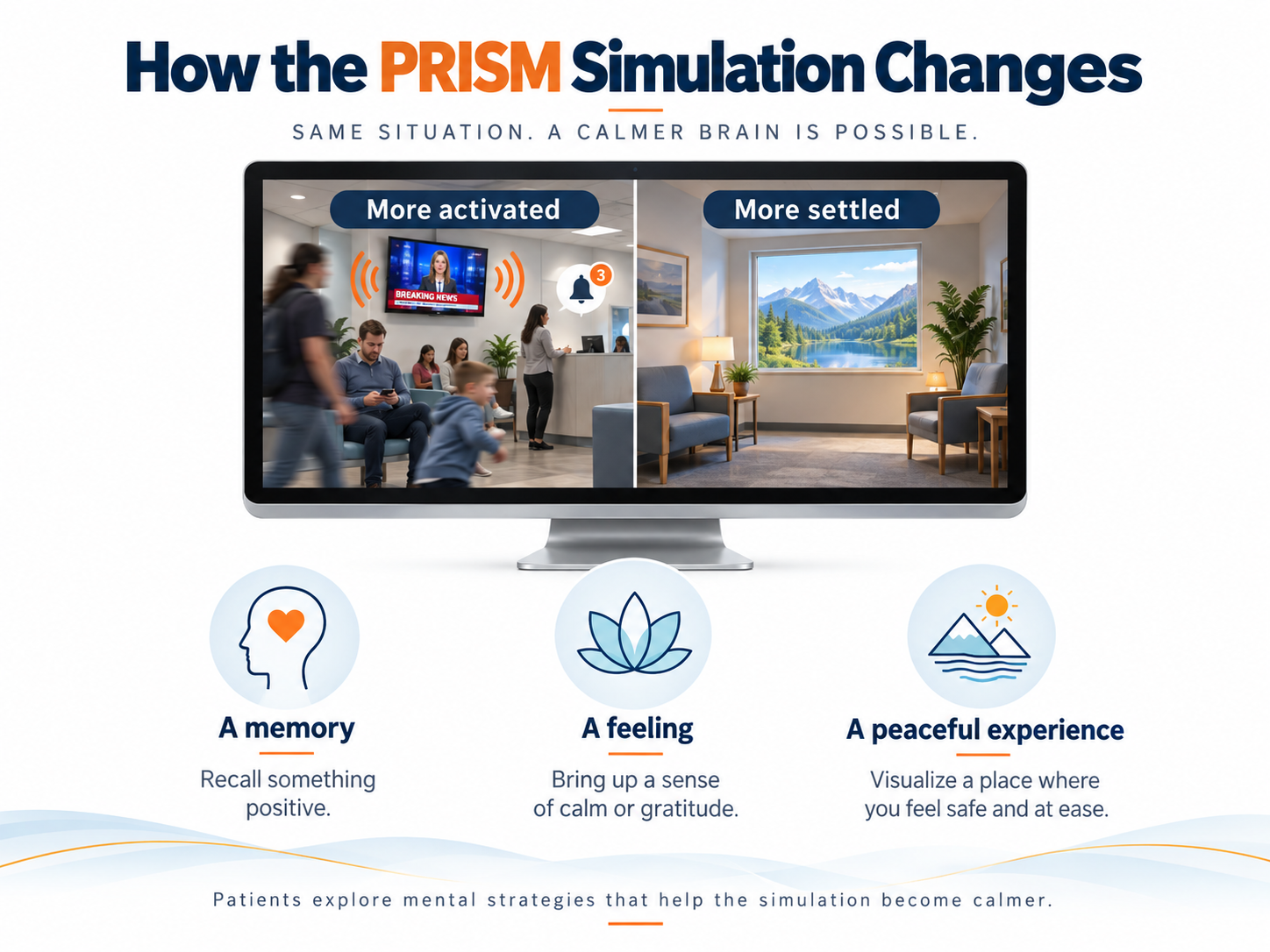
The amygdala runs your alarm system.
It's a small structure deep in the brain that triggers the fight-flight-freeze response automatically, before conscious thought. In PTSD, this system stays switched on longer and fires more readily than it needs to — which is where many symptoms come from.
Prism can see that activity through an EEG cap.
The amygdala sits too deep for EEG to read directly. GrayMatters Health, the company behind Prism, addressed this by recording fMRI and EEG simultaneously and using machine learning to build a digital marker — an EEG signature that tracks amygdala-related activity. This lets a scalp cap stand in for a scanner.
A simulation turns that signal into something you can see.
On the monitor, animated characters in a waiting room are agitated — moving, standing, talking over each other. They respond directly to your brain signal. As the amygdala-related activity comes down, the characters settle, sit, and quiet.
You find what brings it down.
This is your mental strategy: a memory, an emotion, a place, an experience that makes you feel calm and safe. Everyone's is different, and most people try several before one clicks. The screen tells you immediately whether it's working.
Repetition turns it into a skill.
Fifteen sessions of practice, with feedback every few minutes, is training. The goal is that regulating your own state stops being something you concentrate on and becomes something you simply do — in the parking lot, in the crowded room, at that certain time of day.
You'll be in a quiet room with our team
You'll be in a quiet room at our Coral Springs office with a table, a chair and a monitor. Your Prism operator stays with you throughout.
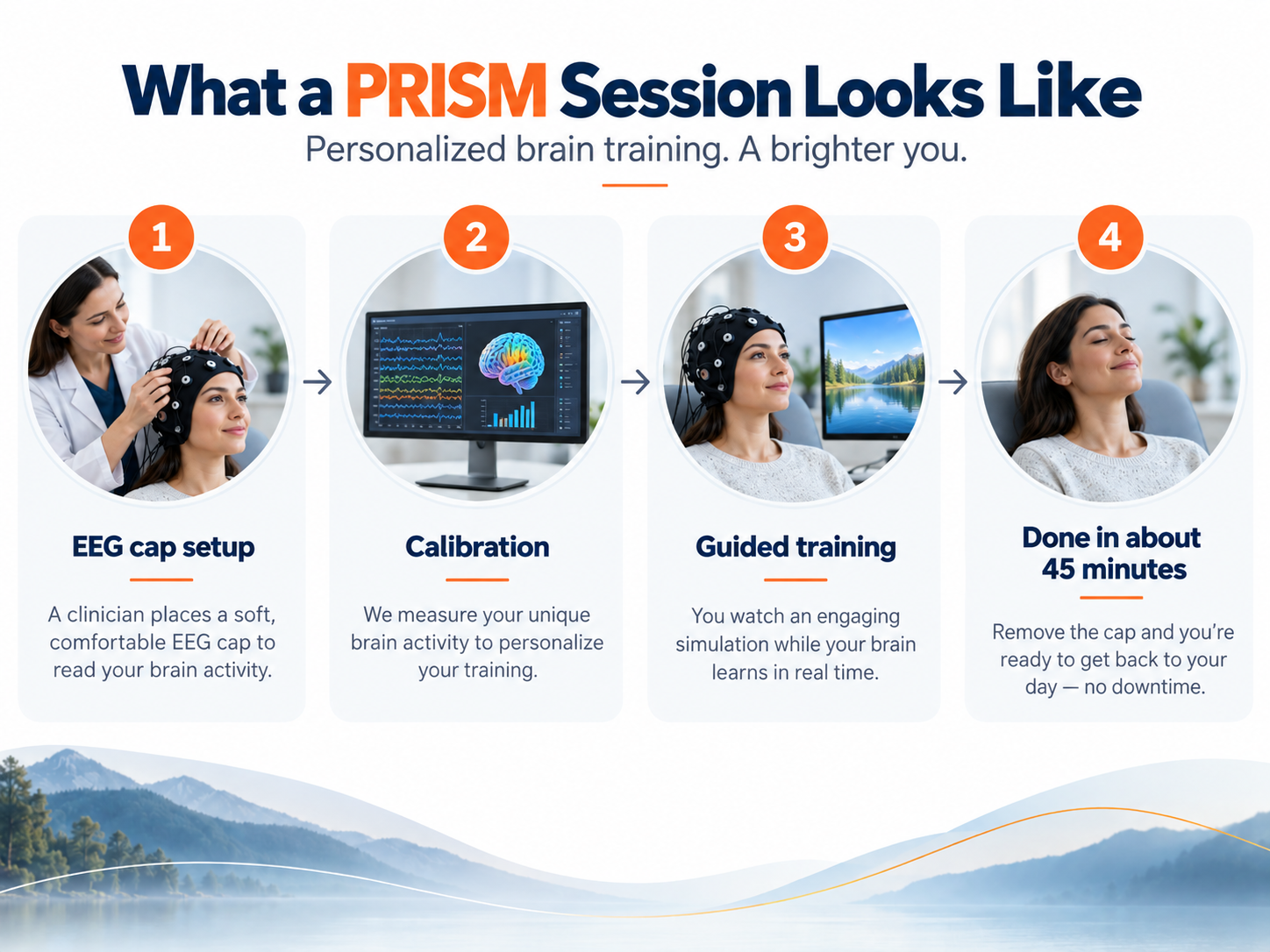
Getting set up.
A soft EEG cap goes on your head, and one small sensor clips to your earlobe. Your operator applies a water-based gel to each sensor for a clean signal — it wipes off easily afterward. Headphones may be used. Phones and smartwatches go off or into airplane mode.
Calibration.
You'll close your eyes for about thirty seconds, then open them at a tone and focus on a marker on the screen. This lets the system take your baseline.
Five cycles.
Each cycle runs about four minutes. You'll watch the scene for a minute first, then instructions and a countdown appear, and then you work your mental strategy while the same scene plays. During each session, your Prism operator reviews graphs showing how the brain activity measured during each cycle responded to the mental strategies you tried. After the five cycles, they can discuss which strategy appeared most effective and which one you may want to practice again.
Finishing.
Your operator removes the cap and gives you a towel for any residual gel. You may be asked about your experience or to fill out a brief questionnaire. Then you go on with your day — there's no recovery time and nothing to plan around.
What we'll ask of you during cycles: sit upright with feet flat and hands resting, keep your eyes open, minimize movement of your head and face, breathe normally rather than deeply, and stay quiet. You can stretch and talk during breaks. If anything is uncomfortable, tell your operator — your only job during a cycle is your mental strategy.
A structured course, tailored to you
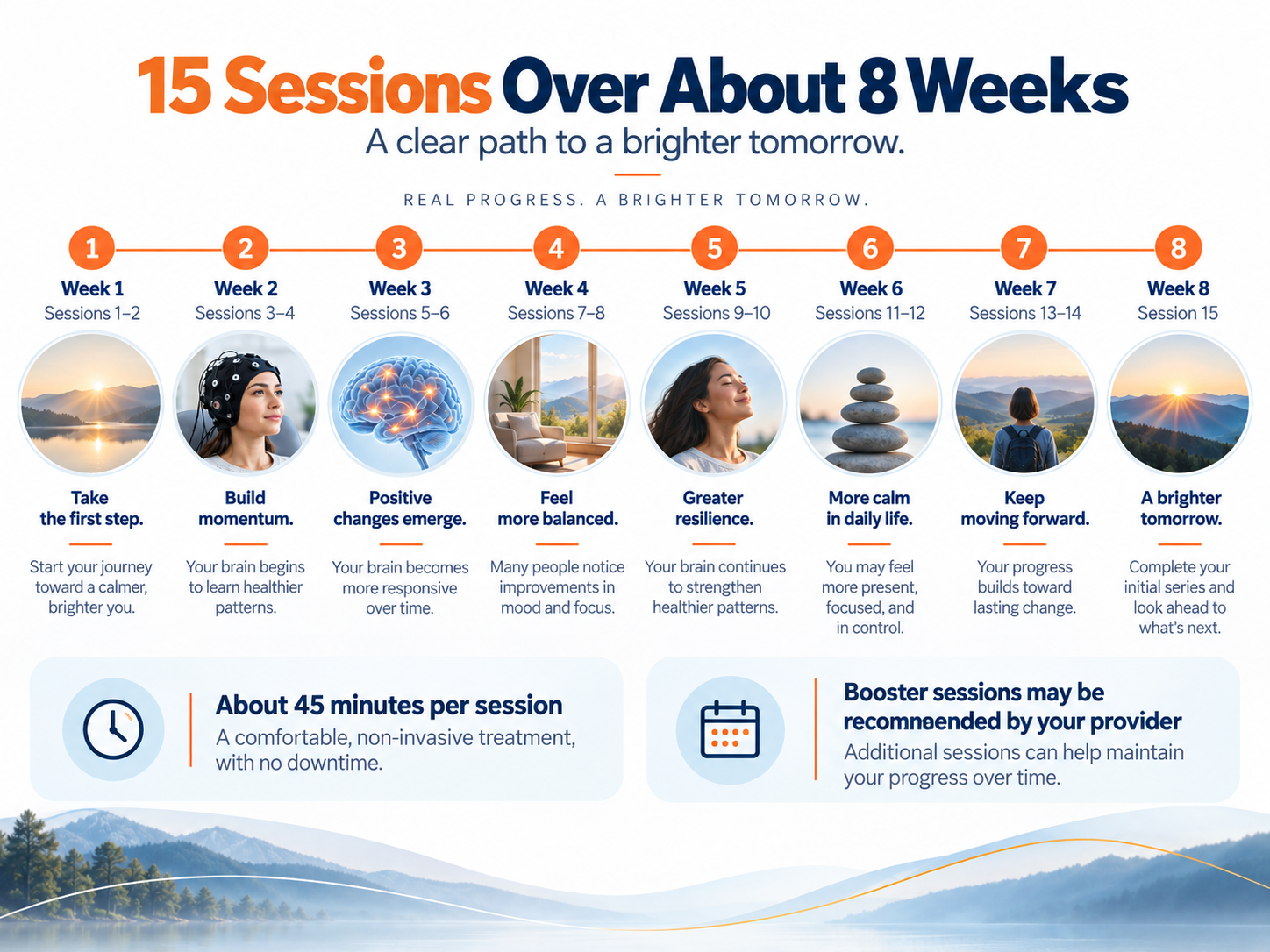
| Sessions | 15 |
|---|---|
| Frequency | Typically twice weekly |
| Duration | About 8 weeks |
| Session length | About 45 minutes |
| Booster sessions | Available if needed |
Your Neuro Wellness provider sets the schedule with you and may adjust it based on your circumstances and response.
Clinical study results
In a prospective, multi-center clinical study, patients were assessed three months after finishing the 15-session course — five months from their starting point.
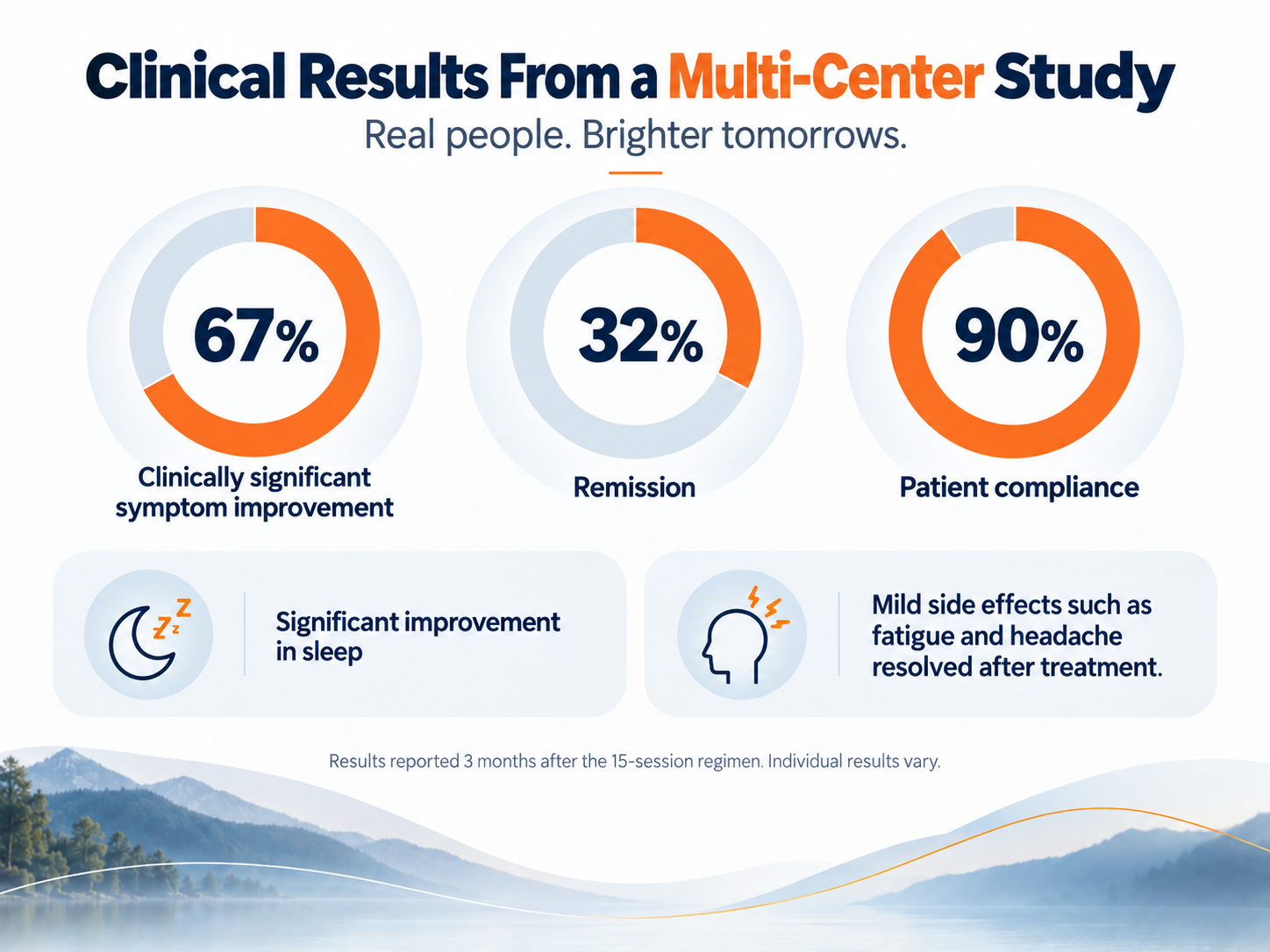
Fruchter E, et al. Amygdala-derived-EEG-fMRI-pattern neurofeedback for the treatment of chronic post-traumatic stress disorder: a prospective, multicenter, multinational study evaluating clinical efficacy. Psychiatry Research. 2024;333:115711.
That 90% completion figure is worth pausing on. Dropout is one of the hardest problems in PTSD care, and a treatment only helps if people can stay with it.
Individual results vary. These are study findings, not a prediction for you. Your provider will discuss what's realistic in your situation.
See Prism in Action
Learn how Prism works, what a session feels like, and what the research shows — directly from the team behind the treatment.
Prism for PTSD — How It Works
Prism — What to Expect
Prism — Clinical Research Overview
Prism — Patient Experience
Mild, well-tolerated, non-invasive
In clinical study, the most commonly reported side effects were mild — headache, dizziness, and fatigue — and resolved on their own after the session ended, without further intervention.
Prism is non-invasive. It does not deliver electrical or magnetic stimulation to your brain; the EEG cap only reads activity, in the way a fitness tracker reads heart rate. There are no injections and no radiation exposure.
Your Neuro Wellness provider will review your full history to determine whether Prism is appropriate for you, and will discuss safety information in detail during your consultation.
Prism works with your current treatment, not instead of it
Prism is cleared for use as an adjunctive treatment — meaning it's designed to be added to your care, under the direction of your healthcare professional, alongside other approaches.
If you're in therapy, you stay in therapy. Some patients find that the regulation skill they build in Prism sessions makes other work more accessible. If you're on medication, decisions about it remain between you and your prescriber — starting Prism doesn't change anything on its own.
Whatever you're already doing, bring it to your consultation. Prism is one part of a plan, and our team will help you see where it fits.
People who’ve been carrying it a long time
Trauma doesn’t look one way, and neither do the people who come to us. Prism may be worth discussing if you are:
A first responder
Firefighters, police, EMS and dispatchers who absorb other people's worst days as part of the job
A Veteran or service member
We're in-network with the VA
A high-functioning professional
Still performing at work, but running on empty everywhere else
A college student or young adult
Dealing with trauma or a flatness that started during school
A survivor
Of assault, an accident, a medical crisis, a loss or a natural disaster
Someone who's already tried therapy, medication or both
And is still carrying more than they should
You don’t need to have it all figured out before you call. Telling us what you’ve noticed is enough to start.
Questions, answered.
A non-medication option to add to your patient’s care
Neuro Wellness TMS Centers of America is an authorized Prism provider in Coral Springs. Prism is a prescription EEG neurofeedback device, FDA-cleared as an adjunct for symptoms associated with PTSD. It adds to the care your patient already receives: they stay with their therapist, and medication decisions stay with their prescriber.
Patients who may benefit
- Chronic PTSD with persistent intrusion, avoidance, mood or hyperarousal symptoms despite therapy and/or medication
- Patients who can't tolerate or don't want to add another medication
- Patients who stall in or avoid trauma-focused therapy (Prism requires no trauma retelling)
- Depression marked by anhedonia (flatness, low motivation, “functional but disconnected”) for our Prism depression protocol (not FDA-cleared for depression; used adjunctively)
What to expect
15 sessions of about 45 minutes, typically twice weekly over about 8 weeks. In a multi-center study, 67% of patients showed clinically significant improvement on CAPS-5 and 90% completed the course (Fruchter E, et al. Psychiatry Research. 2024;333:115711). We send progress updates and coordinate shared care.
How to refer
Use our Physician Referral Checklist or call 954-827-9793. We’re also glad to schedule a lunch-and-learn for your practice on recognizing PTSD clusters and anhedonic depression in high-functioning patients.
Healing is possible, and you don’t have to figure it out alone.
If anything on this page sounded like you, that’s reason enough to reach out. We’ll listen, review what you’ve tried, and tell you honestly whether Prism fits.
A clinical consultation, not a commitment
We'll review your history and what you've tried, talk through whether Prism fits your situation, and answer whatever you want to ask. If it isn't the right fit, we'll tell you that and talk about what might be.