You've Tried Everything. Why Is the Depression Still Here?
If you have a drawer full of old pill bottles and the same heaviness you had two years ago, there is a name for what you're experiencing — and there is a different kind of treatment built for exactly this situation.
Last updated November 3, 2026.
Want to know if SAINT® is right for you?
Tell us about your treatment history and symptoms. A consultation is an evaluation, not a commitment — and it starts with your story.
What 'treatment-resistant' actually means
If you're reading this, there's a decent chance you have a drawer somewhere with old pill bottles in it. Maybe an SSRI you took for a year that helped a little, then stopped helping. Maybe bupropion, which made you jittery and did nothing for your mood. Maybe a sleep aid that got you to sleep but left you foggy, and something "as needed" for the days when the anxiety got loud.
You did what you were told. You gave each one a fair shot. And you are still waking up with the same heaviness you had two years ago.
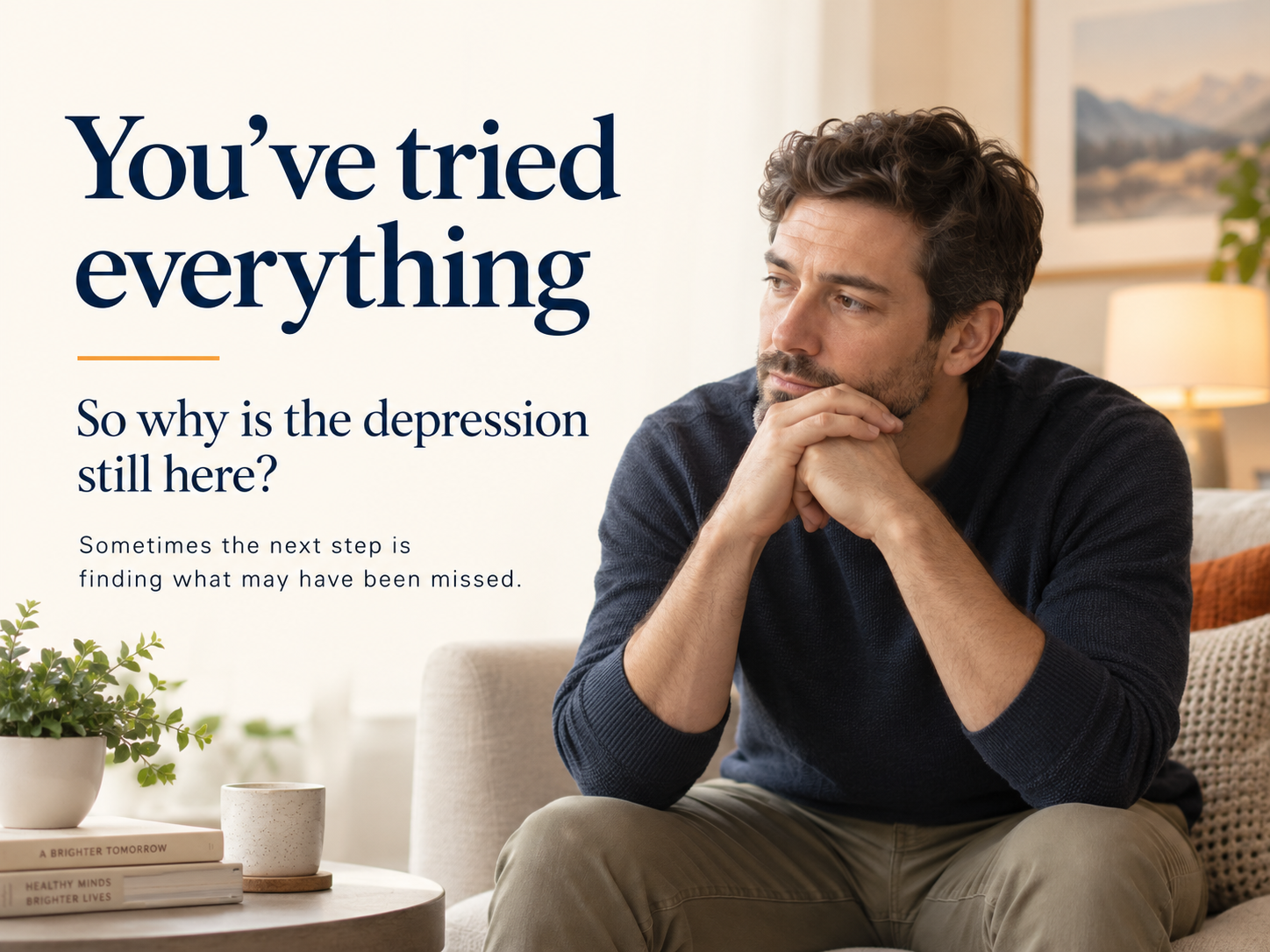
That experience has a clinical name, and it matters that you know it: treatment-resistant depression.
The definition most clinicians use is simple. If you've had at least two adequate trials of antidepressant medication, at a therapeutic dose, for a reasonable length of time, and your depression hasn't lifted, your depression is considered treatment-resistant.
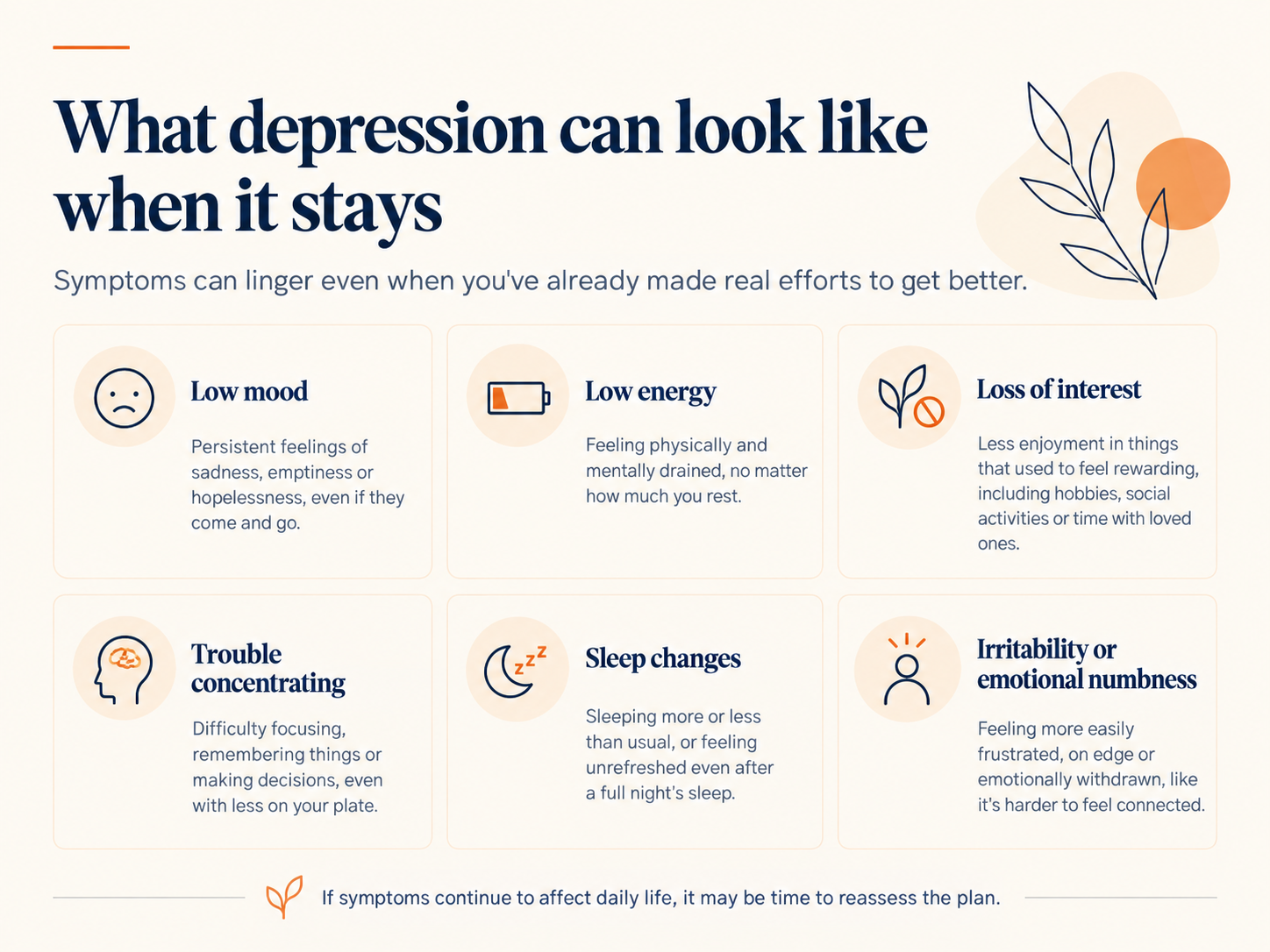
Notice what that definition does not say. It doesn't say you're a difficult patient. It doesn't say you didn't try hard enough, or that you have some unusual, hopeless form of the illness. It says the standard first-line tools didn't work for you, which is true for a large share of people with major depression. Roughly one in three people with depression don't reach remission even after several medication attempts.
You are not an outlier. You are in a well-documented group that simply needs a different approach.
Why medications fail for some people
Antidepressants work by adjusting the chemistry between neurons, mostly serotonin, norepinephrine, or dopamine. For many people that's enough. But depression isn't only a chemistry problem. It's also a circuitry problem.
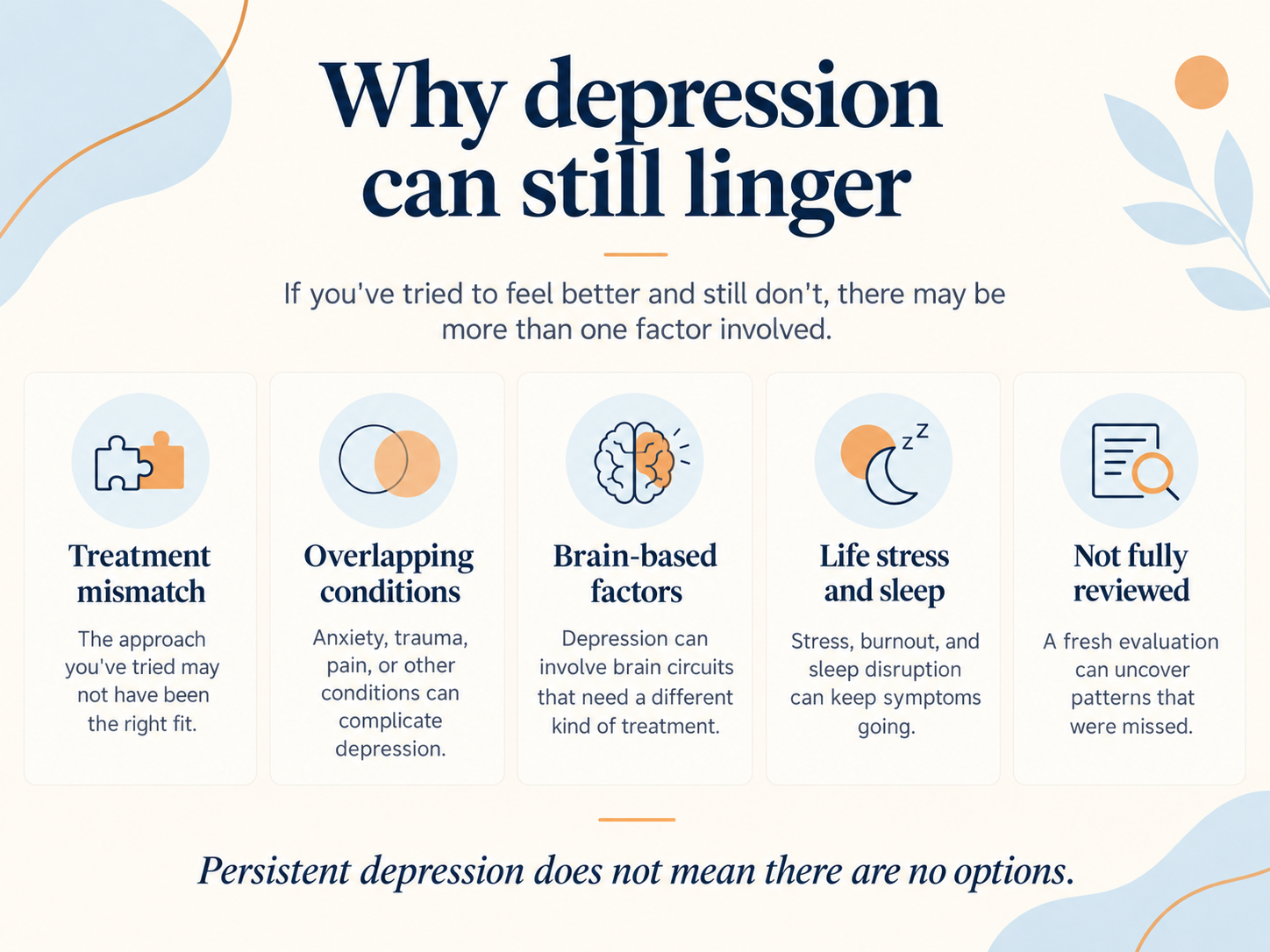
Brain imaging over the last two decades has shown that in depression, certain networks become underactive, particularly the region behind the forehead responsible for regulating mood, motivation, and attention, while other networks involved in rumination and self-criticism become overactive. Medication changes the chemical environment those circuits sit in, but it doesn't directly retrain the circuits themselves.
That's part of why someone can be on a high dose of a good medication, take it faithfully, and still feel like nothing has fundamentally changed. The signal isn't getting through.
The hidden cost of 'just try one more'
There's another reason to name treatment resistance early: every failed trial has a price. Each new medication takes weeks to build up and weeks to taper off. Each one brings its own side effects — dry mouth, headaches, digestive problems, blunted emotions, weight changes. And each one that fails chips away at something harder to measure: your belief that anything will ever work.
Many people arrive at a TMS consultation not because a doctor referred them, but because they got tired. Tired of adjusting doses. Tired of being told the next one might be different. If that's you, that fatigue isn't a character flaw. It's information. It's telling you that repeating the same category of treatment is not a plan.
Curious whether you'd qualify?
If you've tried medication and you're still not yourself, you may be a candidate for SAINT®. Our team will give you a straight answer.
When it's time to consider something beyond medication
Here are some signs that you may be a candidate for a non-medication treatment like transcranial magnetic stimulation (TMS):
- You've tried two or more antidepressants without adequate relief
- You've had partial improvement but still feel like you're operating at half capacity
- Side effects have made it hard to stay on the medications that did help a little
- Your depression keeps coming back after periods of improvement
- You're doing therapy and taking your medication and still feel stuck

You don't have to stop your current medications to pursue TMS. In most cases, patients continue their existing regimen during treatment. TMS isn't a replacement for what you've built; it's an addition that works on a different level.
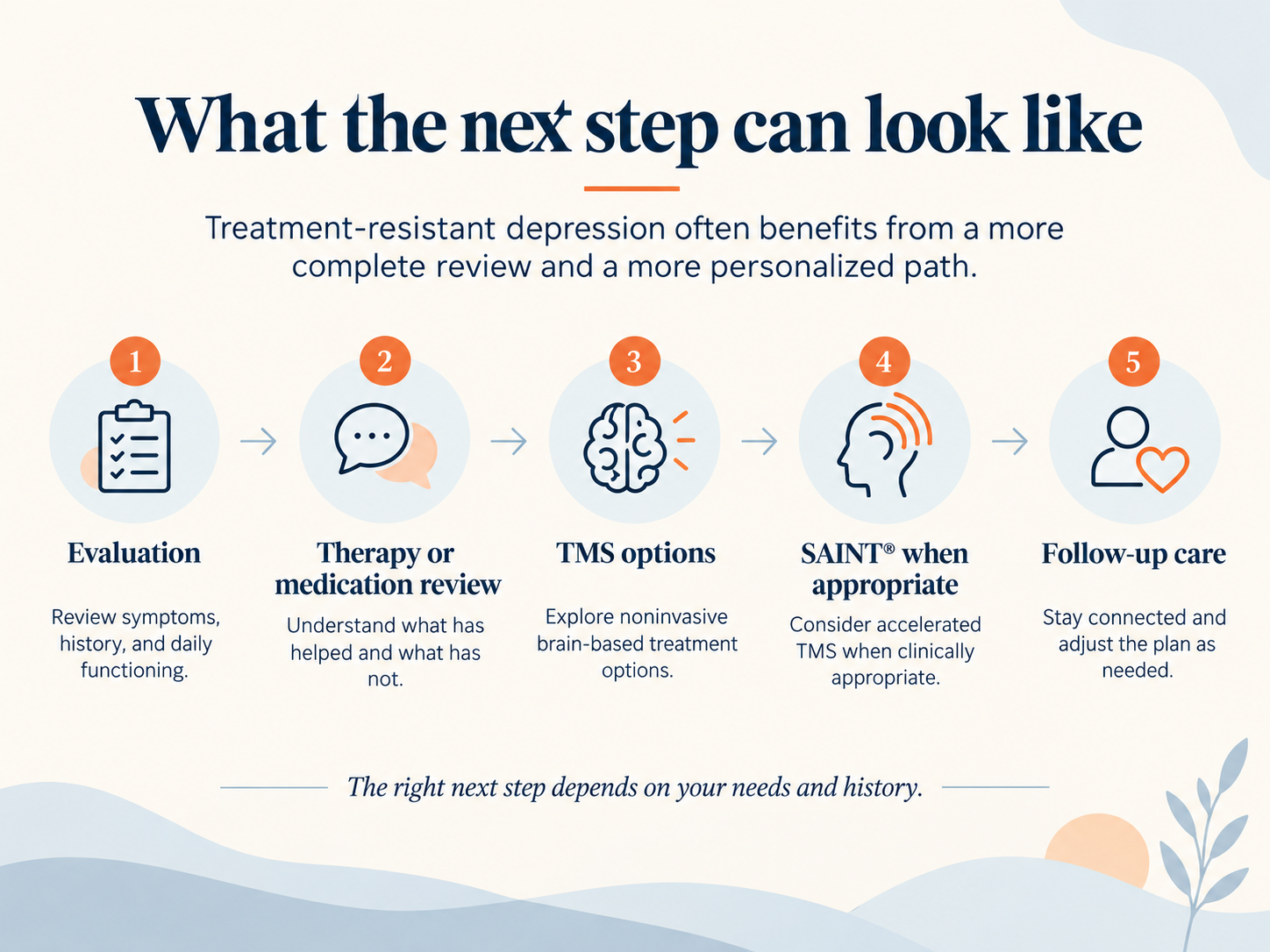
What SAINT does differently
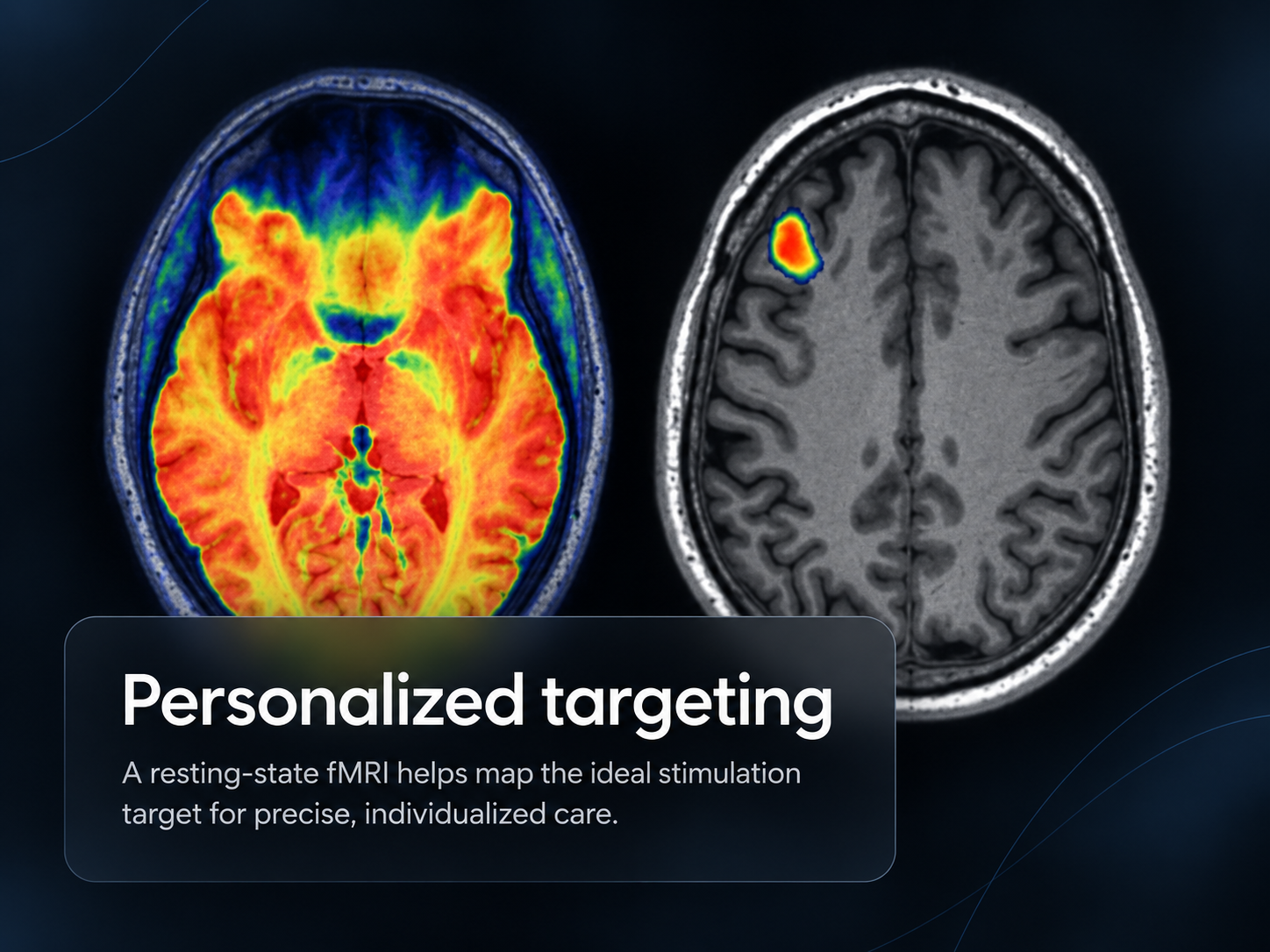
Step 2 & 3 · Personalized fMRI Targeting
A resting-state fMRI maps your individual brain circuitry before treatment begins.
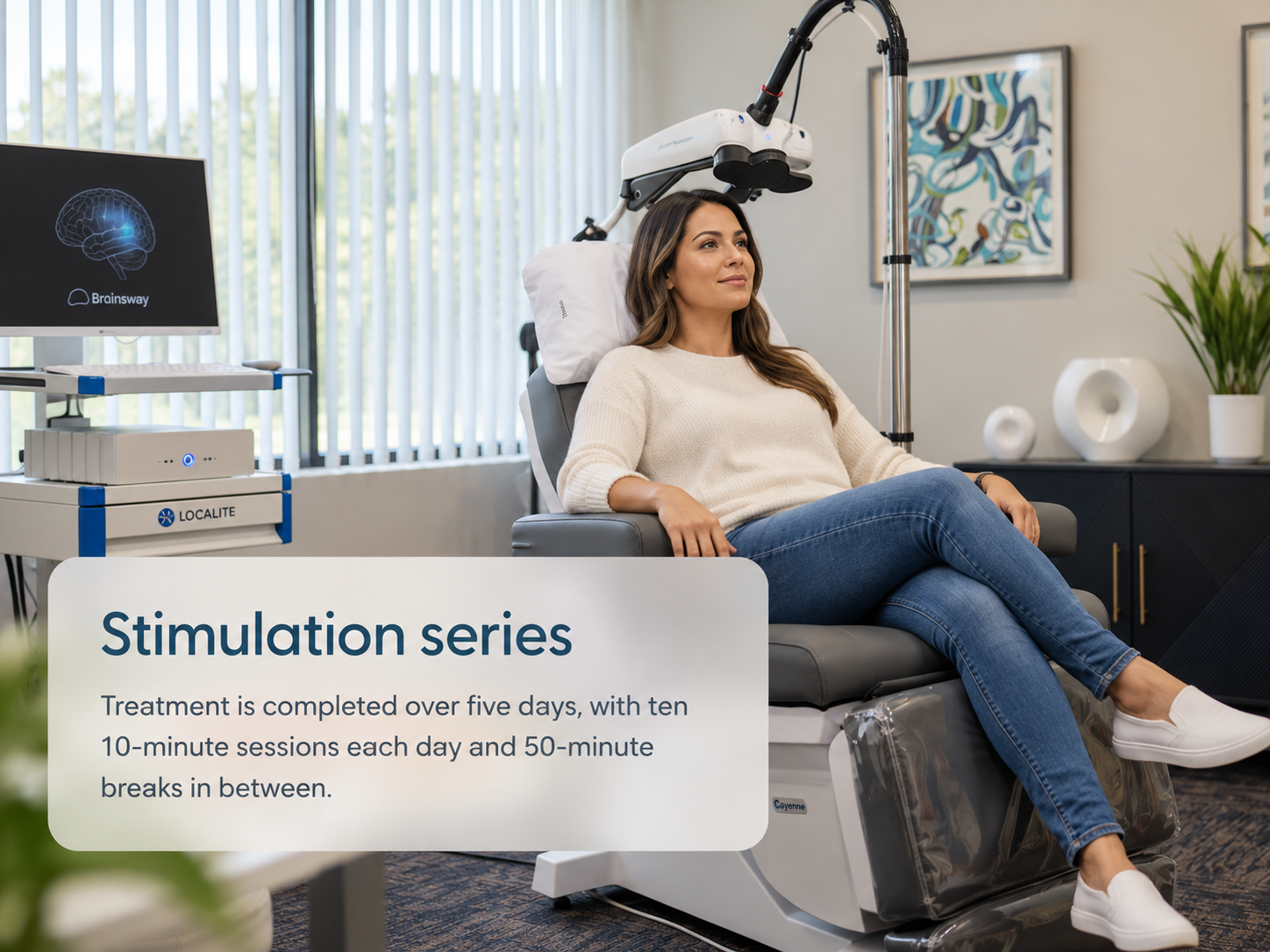
Step 4 · 5-Day Stimulation Series
Ten 10-minute sessions per day with 50-minute breaks; awake and alert throughout.
Standard TMS uses focused magnetic pulses, delivered through a coil placed against the scalp, to stimulate the underactive mood-regulation region of the brain directly. There's no anesthesia and no systemic medication. It works, but it takes six to nine weeks of daily visits, and it locates the target using external measurements of the head rather than a picture of your actual brain.
SAINT (Stanford Accelerated Intelligent Neuromodulation Therapy) is the accelerated, FDA-cleared evolution of that approach. It was developed at Stanford's Brain Stimulation Lab and is indicated specifically for adults with major depressive disorder who haven't gotten adequate relief from antidepressant medication in their current episode. In other words, it was built for the person described at the top of this article.
Here is how the process works at a Verified SAINT® Provider like Neuro Wellness TMS Centers of America:
- Consultation (Zoom web conference). You meet with our clinical team over a convenient Zoom call. As your evaluation evolves, you will also have the option to meet with our psychiatrist by Zoom web conference or in person at our clinic. You meet with our clinical team to review your history, your medication trials, and your current symptoms, and to confirm you're a candidate.
- fMRI brain scan (mandatory in person). An fMRI, taking roughly 45 minutes, maps your brain's individual circuitry. This is the step that separates SAINT from every other depression treatment: no one else's scan is used to plan your care. (Mandatory in-person scan at an imaging partner center.)
- Personalized targeting. A targeting algorithm analyzes your scan to identify the precise spot where stimulation will most effectively reach the depression network. Neuronavigation then guides the coil to that exact location for every session.
- Five-day stimulation series (mandatory in person). In-person treatment Monday through Friday at our Coral Springs clinic. Treatment is ten 10-minute sessions per day, with 50-minute breaks in between, for five consecutive days. That's five clinic visits instead of the 30 to 36 required for conventional TMS. Most patients begin noticing a shift in mood within the first couple of days.
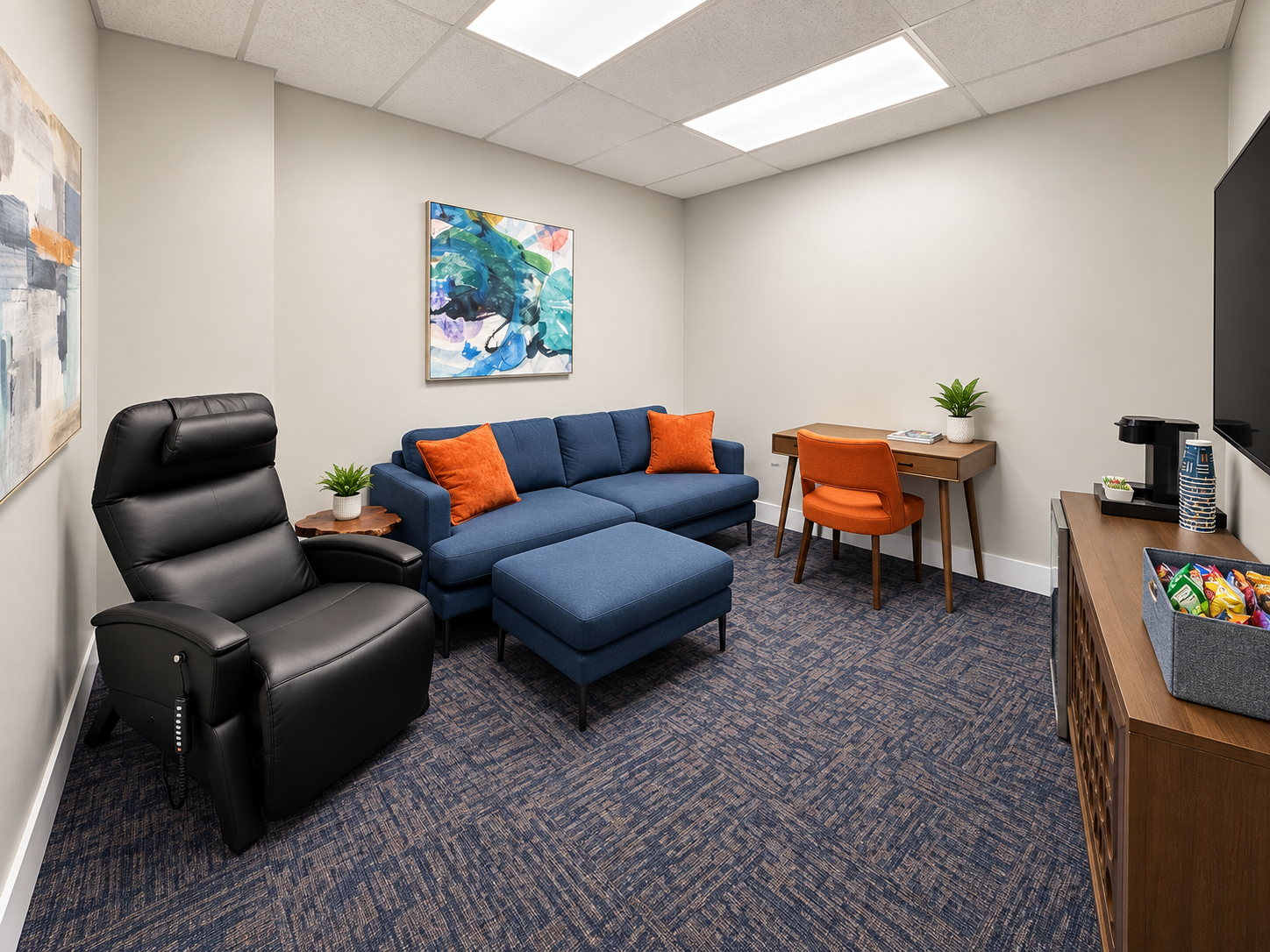
Comfort, Privacy & Dedicated SAINT® Lounge Wing
Between sessions, you relax in a private furnished suite with power recliners, smart TV, quiet workstations, and refreshments. Our on-site care team checks in throughout the day to ensure you have lunch in peace and stay completely comfortable. Companions and family members are warmly welcome.
What the results look like
Data from published trials in treatment-resistant depression. Individual results vary.
In the published clinical trials behind SAINT's FDA clearance, participants had treatment-resistant depression and had already failed prior treatments. Seventy-nine percent reached remission, not merely improvement, and the average time to remission was about two and a half days. Across more than 400 patients treated in trials, 85 percent experienced symptom relief, with no serious adverse events.
The most common side effects were mild headache, fatigue, and temporary scalp discomfort at the treatment site, which typically resolve on their own. SAINT isn't appropriate for everyone: people with non-removable metal in or near the head or an implanted medical device aren't eligible, and your provider will screen for these at the consultation.
You don't have to stop your current medications to pursue SAINT. Most patients continue their existing regimen through treatment. It isn't a replacement for what you've built; it's a different kind of intervention aimed at the circuitry your medications have never been able to reach.
What to do next
If you recognized yourself in the first paragraph of this article, you've already done the hard part: you've kept going. The next step is smaller than you think. At Neuro Wellness TMS Centers of America, the first appointment is an evaluation, not a commitment. We'll review your medication history, your current symptoms, and your goals, and we'll tell you honestly whether SAINT is a good fit. If it is, we'll walk you through the scan, the schedule, and what to expect during your treatment week. If it isn't, we'll tell you that too. Schedule a consultation: 954-827-9793.
Questions About Treatment-Resistant Depression & SAINT
What does treatment-resistant depression mean?
How many people don't respond to antidepressants?
Do I have to stop my current medication to try SAINT?
Is SAINT the same as regular TMS?
What if SAINT isn't appropriate for me?
Explore Related Resources
Why Am I So Tired All the Time? Depression Fatigue
How depression drains energy and why rest doesn't fix it.
Can Depression Cause Physical Pain?
Why depression hurts and what helps.
High-Functioning Depression Symptoms: 10 Quiet Signs
Everyday habits that can be quiet signs of depression.
What Is Treatment-Resistant Depression?
A clear explanation of the term and when it may apply to your experience.
What Is SAINT TMS Therapy?
How the five-day, fMRI-guided protocol works.
Ready to talk to someone?
The hardest part is usually the first phone call. Everything after that is a series of small, defined steps.
You've Kept Going. Let's Find What's Next.
If antidepressants haven't worked, there is a different kind of treatment built for exactly this situation. Speak with our team about whether SAINT may be appropriate for you.