Understanding Your PHQ-9 and GAD-7 Scores (And Why 'Moderate' Can Still Mean Severe)
At some point in your treatment, someone handed you a clipboard with two short questionnaires. You circled numbers, handed it back, and maybe glanced at a total. Understanding what those numbers mean — and what they don't — helps you have better conversations with your treatment team.
Last updated November 3, 2026.
Want to know if SAINT® is right for you?
Tell us about your treatment history and symptoms. A consultation is an evaluation, not a commitment — and it starts with your story.
The PHQ-9: measuring depression
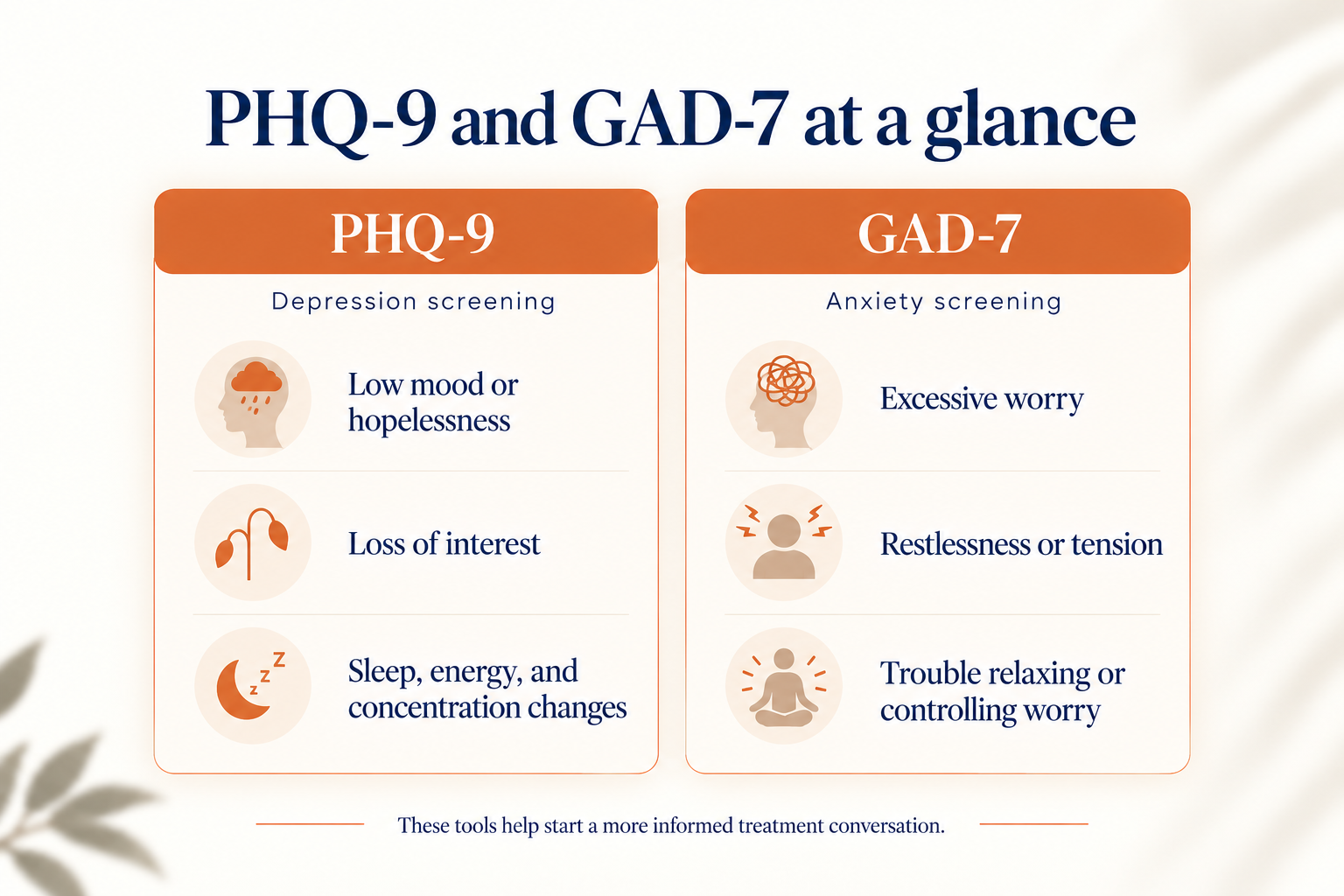
The PHQ-9 asks how often, over the last two weeks, you've been bothered by nine things: low interest or pleasure, feeling down, sleep problems, low energy, appetite changes, feeling bad about yourself, trouble concentrating, being slowed down or restless, and thoughts of being better off dead or hurting yourself.
Each item is scored 0 (not at all) to 3 (nearly every day). The total ranges from 0 to 27.
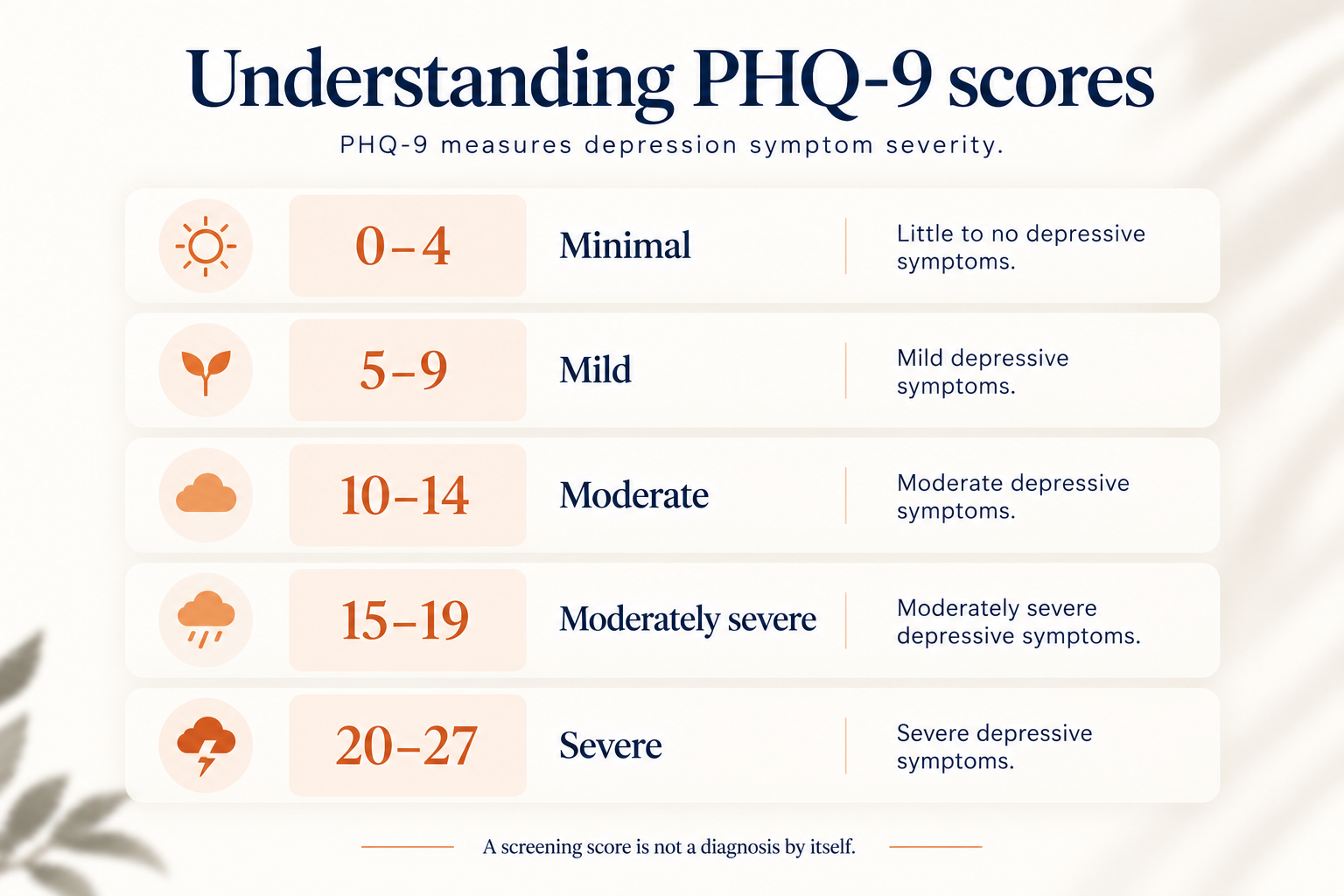
PHQ-9 Score Bands
See if SAINT® is right for you
Five questions. No obligation. A real answer from our clinical team.
See if SAINT® is right for you
Five questions. No obligation. A real answer from our clinical team.
The GAD-7: measuring anxiety
The GAD-7 uses the same two-week window and the same 0-to-3 scale, across seven items: feeling nervous, being unable to stop worrying, worrying too much about different things, trouble relaxing, restlessness, irritability, and feeling afraid something awful might happen.
The total ranges from 0 to 21.
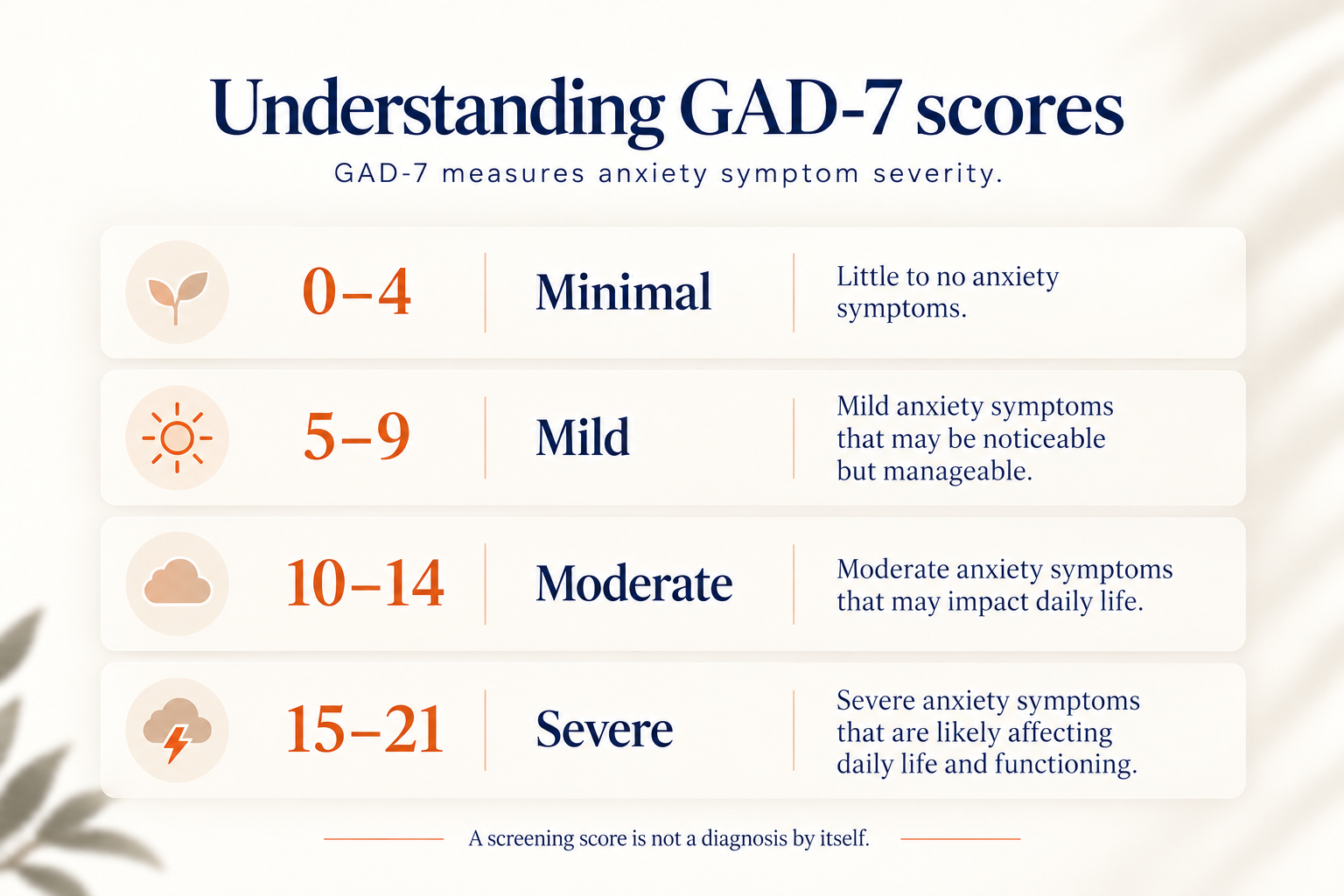
GAD-7 Score Bands
Why a 'moderate' score can come with a 'severe' diagnosis
This is where people get confused, and understandably so. You might score a 13 on the PHQ-9, land in the "moderate" band, and then see "Major depressive disorder, recurrent, severe" on your paperwork. How can both be true?
The answer is that they're measuring different things.
The PHQ-9 is a snapshot. It captures how frequently you've experienced symptoms over the past fourteen days. Your diagnosis is a clinical judgment that takes in the full picture: how long the depression has lasted, how many episodes you've had, how much it's affected your life, and how you've responded to treatment.
Someone who is currently taking an antidepressant, seeing a therapist, and working hard to hold their life together may score in the moderate range precisely because the treatment is doing something. But if the depression has recurred multiple times, hasn't responded adequately to several medications, and has disrupted work, relationships, and health, a clinician may still classify it as severe. The score reflects two weeks. The diagnosis reflects years.
There's also a pattern worth noticing in how people score. Someone might rate sleep, energy, and concentration as "nearly every day" but mood as only "more than half the days," and deny problems with self-esteem or thoughts of self-harm. That produces a moderate total, but the individual items tell a story: the physical and cognitive toll is heavy, even if the emotional distress is being held in check.
What the scores are actually for
These questionnaires aren't a test you pass or fail, and they aren't the basis for your diagnosis. They serve three purposes.
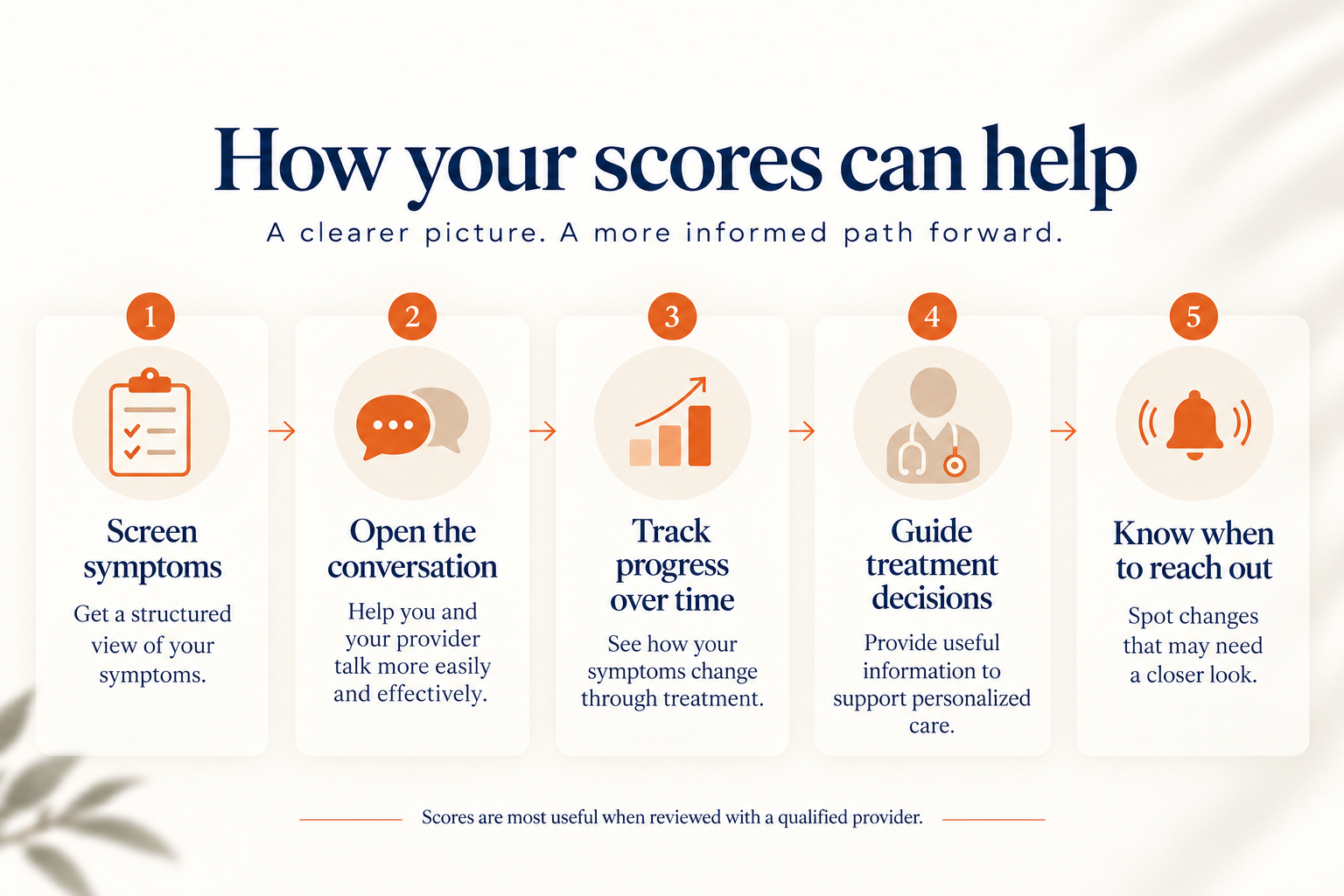
- Screening. They flag when someone should be evaluated further.
- Baseline. They give a starting point so progress can be measured. This matters enormously for treatments where change happens quickly and needs to be tracked objectively.
- Tracking. Repeated scores over time show whether treatment is working. A drop from 13 to 4 is meaningful. A score that sits at 13 for six months while you cycle through medications is meaningful too, in a different way.
In depression research and in TMS clinics, remission is typically defined as a PHQ-9 score below 5. Not "a little better." Below 5. That's the target.
Curious whether you'd qualify?
If you've tried medication and you're still not yourself, you may be a candidate for SAINT®. Our team will give you a straight answer.
When a stuck score becomes a decision point
If your PHQ-9 has hovered in the same range across two or more medication trials, that isn't a failure on your part. It's data. It tells you the treatments tried so far aren't reaching the problem.
Antidepressants work on brain chemistry. But depression is also a circuitry problem. Brain imaging consistently shows that the region behind the forehead called the dorsolateral prefrontal cortex, which regulates mood, motivation, and attention, is underactive in depression. Medication changes the chemical environment around that circuit. It doesn't directly retrain it, which is why a score can plateau no matter how many times the dose is adjusted.
Transcranial magnetic stimulation (TMS) works on the circuit itself, using focused magnetic pulses to stimulate that underactive region directly, with no anesthesia and nothing entering your bloodstream.
What SAINT does to the numbers
SAINT (Stanford Accelerated Intelligent Neuromodulation Therapy) is an accelerated, FDA-cleared form of TMS developed at Stanford's Brain Stimulation Lab. It's indicated for adults with major depressive disorder who haven't gotten adequate relief from antidepressants in their current episode, which is another way of saying: people whose scores haven't moved.
Data from published trials in treatment-resistant depression. Individual results vary.
In the clinical trials behind its clearance, 79 percent of participants reached remission, with an average time to remission of 2.6 days. Across more than 400 trial patients, 85 percent experienced symptom relief, with no serious adverse events. For comparison, remission rates in similar treatment-resistant populations run about 14 percent for another medication trial and 17 to 32 percent for standard TMS.
Here's how it works at a Verified SAINT Provider like Neuro Wellness TMS Centers of America:
- Consultation (Zoom web conference). You meet with our clinical team over a convenient Zoom call. As your evaluation evolves, you will also have the option to meet with our psychiatrist by Zoom web conference or in person at our clinic. You meet with our clinical team, complete a fresh PHQ-9 and GAD-7 for a baseline, and review your full history to confirm you're a candidate.
- fMRI brain scan (mandatory in person). A roughly 45-minute functional MRI maps how your individual brain networks are wired. (Mandatory in-person scan at an imaging partner center.)
- Personalized targeting. A targeting algorithm reads your scan and identifies the exact location for stimulation. Neuronavigation guides the coil to that spot for every session.
- Five-day stimulation series (mandatory in person). In-person treatment Monday through Friday at our Coral Springs clinic. Ten 10-minute sessions per day, with 50-minute breaks in between, for five consecutive days. Five clinic visits, compared with 30 to 36 for conventional TMS. Your scores are tracked throughout, so you and your care team can see the change as it happens.
Side effects were generally mild in trials: headache, fatigue, and temporary scalp discomfort. SAINT isn't appropriate for people with non-removable metal in or near the head or an implanted device, and you'll be screened at your consultation. You don't have to stop your current medications; most patients continue their existing regimen.
What the scores can't tell you
They can't tell you why you're depressed. They can't distinguish between depression that will respond to medication and depression that won't. They can't measure how much effort you're spending to function, or how many years this has been going on. And a low score on the self-harm item does not mean your depression isn't serious.
What to do next
If you've been watching your scores plateau, or if the gap between your "moderate" number and how you actually feel has been bothering you, bring that to a consultation.

At Neuro Wellness TMS Centers of America, the first appointment is an evaluation, not a commitment. We use these tools the way they're meant to be used: as a starting point for a conversation, not a verdict. We'll review your scores alongside your full history and tell you honestly whether SAINT is likely to move them. We offer private outpatient care with a dedicated care team and weekend availability. Insurance coverage varies by plan; our team can help you understand your options, including prior authorization and self-pay.
Schedule a consultation: 954-827-9793
If you are in crisis or thinking about harming yourself, please call or text 988 (Suicide and Crisis Lifeline) or go to your nearest emergency room. This article is for educational purposes and is not a substitute for individual medical advice.
See if SAINT® is right for you
Five questions. No obligation. A real answer from our clinical team.
See if SAINT® is right for you
Five questions. No obligation. A real answer from our clinical team.
Frequently Asked Questions
What is the PHQ-9?
What is the GAD-7?
Can I have a 'moderate' score and still be diagnosed with severe depression?
What PHQ-9 score means remission?
Why has my score been stuck for months?
Do the PHQ-9 and GAD-7 diagnose me?
Explore Related Resources
You've Tried Everything. Why Is the Depression Still Here?
What treatment-resistant depression means and why a circuit-level approach may help.
SAINT TMS, Plainly: What It Is, Who It's For, and What Happens
A plain-language guide to SAINT TMS, eligibility, and the treatment process.
Am I a Candidate for TMS?
What clinicians consider when evaluating TMS eligibility.
SAINT® TMS in Coral Springs, FL
The full SAINT treatment page with outcomes, cost, and FAQs.
Ready to talk to someone?
The hardest part is usually the first phone call. Everything after that is a series of small, defined steps.
You Don't Have to Figure This Out Alone
Schedule a Consultation